


Last month, at the ITS European Congress in Istanbul, the Demonstration Area became a broadcasting hub featuring four EU-funded initiatives which held a joint live-streamed webinar: the EvoRoads, FRODDO, ZEV-UP, and NextETRUCK projects, alongside the ERTICO Platform EAVP (Enhancing Automated Valet Parking).
Moderated by José Rodríguez, the webinar brought the ITS Congress exhibition floor in Istanbul to a global audience by showcasing the vehicles, technologies and real-world innovations presented on site. It also demonstrated how EU-funded projects are turning research into practical applications in Cooperative, Connected and Automated Mobility (CCAM), Urban Green Mobility, road safety and transport optimisation, and offering accessible, deployment-oriented insights for both mobility professionals, citizens and students interested in the future of transport. Innovation in Action: 5G and Remote Operation.
Live demonstration operated remotely from the ERTICO European Pavilion
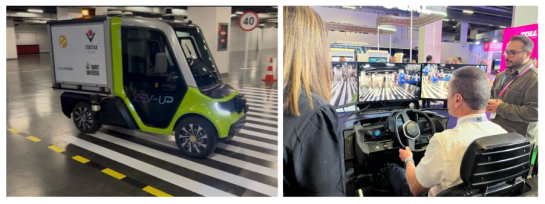
Against the backdrop of the live broadcast, a real-time demonstration featured the ZEV-UP's electric light delivery vehicle being remotely operated directly from approximately 500 meters away, controlled directly from the ERTICO exhibition stand.
Powered by high-speed, low-latency 5G connectivity, the demonstration, developed in collaboration with key ERTICO partners, including Ford Otosan, served as a tangible example of how next-generation network technologies are unlocking the safe, efficient, and scalable deployment of automated logistics and urban delivery services.
Strategic Visions and Collaborative Progress
The webinar featured a lineup of speakers who shared both the strategic direction and the rigorous delivery of how to bring these advanced solutions closer to market and everyday commercial viability.
Contributions from ERTICO team members, Emil Berlin, Emin Aliyev, Maria Alonso-Raposo, Alastair Kitson, and George Christou, offered deep dives into how their respective initiatives are reshaping the European transport landscape:
Emil Berlin highlighted the organisation’s massive ecosystem of over 120 partners spanning public authorities, industry actors, and transport cities, bridging the gap between research and real-world ITS deployment.
Alistair Kitson introduced the Enhancing Automated Valet Parking platform, detailing a seamless future where smart infrastructure guides automated vehicles to park and charge themselves autonomously, freeing up urban space and simplifying the city user journey.
Project Coordinator Emin Aliyev brought ZEV-UP’s work on affordable, frugal, and ultra-compact zero-emission vehicles, integrating also swappable battery systems to the stage. He revealed an ambitious market goal: targeting an affordable price tag in the range of €8,500 for the baseline passenger variant, aiming to drastically cut vehicle footprint and urban space needs.
George Christou explained how the FRODDO project ensures automated vehicles operate safely by mapping Operational Design Domains (ODDs). Using an open-source single digital twin platform (the Crimson platform), FRODDO helps road authorities manage fleets across diverse weather conditions and complex factory environments, such as its active heavy tow-truck pilot in Bursa, Turkey.
Maria Alonso-Raposo detailed how EvoRoads is shifting road safety from reactive crash analytics to proactive risk management. By dynamically assessing road readiness and mapping pavement defects (potholes and cracks) across six European test locations, the project aims to accelerate the EU's "Vision Zero" goal of eliminating road fatalities by 2050.
Driving Deployment Through User Acceptance and Stakeholder Co-Creation
As the panel discussion shifted from raw technology to real-world deployment, a powerful consensus emerged: scaling smart mobility is a human challenge, not just an engineering one. The project coordinators emphasised that the ultimate success of these initiatives hinges entirely on public participation and user acceptance.
Emin Aliyev initiated this dialogue by addressing how user expectations shift dramatically across borders.
For the ZEV-UP ultra-compact electric vehicles, he explained that affordability and physical utility must match local realities. By launching real-world pilots across a spectrum of environments, from the hyper-dense urban centre of Istanbul to distinct markets in Greece and Romania, the project is actively gathering regional feedback to ensure these vehicles fit the daily routines of everyday citizens and fleet operators alike.
The conversation then turned to navigating the distinct institutional and social frameworks within Europe
George Christou noted that moving automated driving technologies from isolation out into the open requires preparing society early to embrace them. As European municipalities possess vastly different transit and operational cultures, the best approach is to provide local stakeholders, including cities, drivers, and transport authorities, with a shared playing ground where they can visualise, interact with, and confidently co-create these systems before they hit public roads.
Finally, Maria Alonso-Raposo introduced an inclusive vision for EvoRoads that transforms passive commuters into active safety contributors. Rather than leaving citizens on the sidelines, she envisioned a community-driven safety ecosystem. Through a smart infrastructure platform, everyday travellers can use their smartphones to check road safety ratings before taking a trip, while proactively reporting hazards like potholes and pavement defects directly to local authorities for rapid repair.
Turning Mobility Research and Innovation into Market Reality
The collaborative nature of the session underscored ERTICO’s core mission: bringing together diverse stakeholders, from research projects to industry leaders, to accelerate the deployment of Intelligent Transport Systems. By combining zero-emission vehicle design with 5G connectivity and advanced automation, these projects are proving that the future of mobility is not just a concept, but a rapidly approaching reality.
However, scaling these solutions requires overcoming remaining hurdles. While the core technology exists, ERTICO continues to play a pivotal role in clarifying regulatory frameworks and technological standards to ensure these innovations are deployed safely and effectively for the benefit of society.
The webinar served as a vital platform for identifying new routes of cooperation and synergy between the participating projects.
See the live-streamed 5G teleoperated vehicle in action, and listen to the complete expert insights directly on the ERTICO YouTube Channel.
An Evolving Landscape of European Projects Building the Technical Programme for ITS European Congress 2026 CHORUS joins the EU Road Safety Cluster and strengthens ERTICO's Commitment to Road Safety Driving the European Mobility Agenda at Intertraffic Amsterdam 2026 ERTICO Academy launches NextETRUCK course for truck fleet electrification ERTICO Highlights its Activities at the 17th ITS European Congress ERTICO projects bring smarter mobility to European Mobility Week EU Projects Showcase Future of CCAM and Urban Green Mobility EU-projects at TRA 2026: Connecting research, deployment and policy for European mobility Europe’s Mobility Leaders Set the Course for Istanbul 2026