
The NextETRUCK project has successfully concluded, advancing zero-emission solutions for regional medium-duty freight. The project showcased its innovations in digital twins, fast charging and charging software and two of its three trucks at the Final Event, paving the way for future decarbonisation initiatives in urban and regional freight transport.
For 51 months, the NextETRUCK project consortium has worked to address a pressing issue for the transport sector: decarbonising urban and regional freight. While Heavy-Duty Vehicles (HDVs) typically dominate the discussion, electrifying medium-duty trucks is essential to meet evolving city requirements and the rise in last-mile deliveries.
Key Objectives & Achievements
NextETRUCK fulfilled six ambitious objectives:
- Tailored ZEV Concepts: Developed medium-duty electric haulage concepts achieving at least a 10% increase in energy efficiency over top benchmark EVs.
- Digital Twin & Fleet Tools: Created advanced vehicle Digital Twins and digital fleet management tools for virtual zero-emission vehicle (ZEV) integration.
- Optimised Powertrain Design: Built a vehicle architecture design tool to optimize sizing, safety, and component integration, lowering Total Cost of Ownership (TCO).
- Smart Fast-Charging Infrastructure: Demonstrated a cost-efficient, flexible fast-charging concept adaptable to diverse fleet operations.
- Market-Ready Business Models: Designed scalable business structures to boost end-user acceptance and accelerate market adoption.
- Real-World Demonstration: Validated concepts across three real-world use cases in Barcelona, Istanbul and the UK.
Driving innovation and exploitation
The consortium leaves behind a strong legacy of tools, knowledge, and intellectual property, including three patents by Ford Otosan. Key tools developed include CENEX Nederland’s KITE (helping small fleet operators with fewer than 20 trucks plan depot electrification) and CENEX UK TEIDE (forecasting energy-based utilization at en-route charge points for CPOs). Furthermore, long-term capacity building is secured through a training programme hosted under the ERTICO Academy.
ERTICO has played a key role in leading NextETRUCK’s Innovation Management and Exploitation for the technical and commercial uptake of the project’s results. .
NextETRUCK Final Event
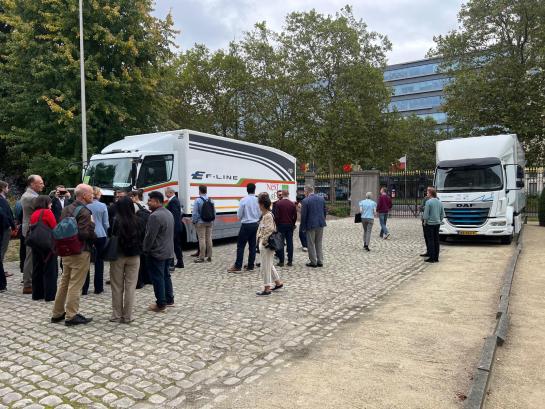
To share these advancements, the NextETRUCK consortium held its Final Event on 28 September in the Academie Palace in Brussels. DAF UK and Ford Otosan’s trucks were the stars of the gathering. During the events, key partners focused on some of the project´s innovations, highlighting the collaborative efforts.
AVL (Digital Twin): Presented the Model.CONNECT co-simulation coupling tool, establishing a cloud-based pipeline using Ford Otosan data to generate rapid Digital Twins via machine learning. Demonstrating the tool on a vehicle cooling system, AVL achieved a 15% reduction in cooling power alongside potential cost and sizing reductions, paving the way for mainstream DT adoption in vehicle production and fleet aftermarket care.
JEMA (Fast Charging): Highlighted power converter innovations developed in collaboration with VUB. Using model predictive control and Digital Twin modelling, JEMA simulated and validated converter behaviour prior to physical testing, ensuring seamless charger hardware integration.
K2/Panion (Charging Software): Tackled operational hurdles such as grid congestion, transparent kWh pricing, and complex routing. Their monitoring platform simplifies depot operations at scale while removing route uncertainty for drivers during public charging.
During the event, key results were also shown from the three pilot sites, where the trucks proved the delivery of positive outcomes on efficiency and operational viability:
Ford (Istanbul): Regional transport achieving a 25% energy consumption improvement (0.57 kWh/km) and supporting double-shift operations without intermediate charging.
Irizar (Barcelona): Municipal waste collection featuring a 115% range increase, zero operational limitations, and high driver satisfaction scores.
DAF (UK): Urban distribution offering a 200+ km real-world range at max payload and energy consumption under 0.82 kWh/km.
The NextETRUCK aftermath
As CINEA noted during the event, it is particularly important to exploit project results by advancing them into further research and innovation or to market, helping move promising ideas into practical solutions.
The project joined forces with other EU-funded initiatives under the AEVETO cluster, which will now be a relevant force boosting the project’s legacy.
Download the project’s Brochure
NextETRUCK concludes with three operative trucks and several innovations for logistics decarbonisation ERTICO Academy launches NextETRUCK course for truck fleet electrification DEKRA accelerates the rollout of zero-emission trucks ERTICO Insights from the European Parliament STOA Workshop EU Projects Showcase Future of CCAM and Urban Green Mobility
