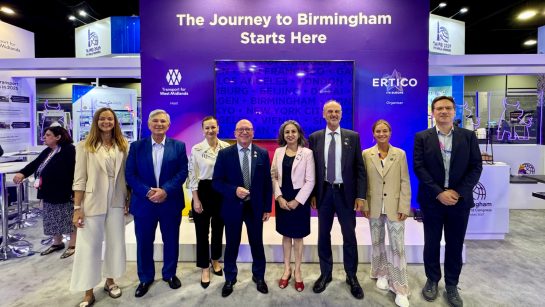


Members of the ERTICO team and Partnership joined 6,000 keen participants from the transport and mobility ecosystem at the recent ITS World Congress in Atlanta. Policymakers, industry leaders, innovators, and researchers highlighted once again why this annual event, which rotates around the Americas, Asia Pacific and EMEA regions, is so valued by all invested in smart transport and mobility. Global approaches to and priorities regarding ITS may differ, but collaboration across borders will determine whether ITS fulfils its promise or falls short.
In Atlanta, the Congress theme 'Deploying Today, Empowering Tomorrow' came to life both in sessions and on the streets, where robotaxis operated in live conditions and integration technologies and solutions between road infrastructure, vehicles and other road users were deployed. The excitement was tangible as participants booked Waymo rides directly through the Uber app. While giving a glimpse of mobility’s future already in action, Atlanta also made history by establishing the nation’s first “Day One Deployment District” for Cellular Vehicle-to-Everything (C-V2X) technology.
Some of the themes that echoed throughout the Congress included safety, accessibility, data, interoperability, economic competitiveness, and collaboration. What follows is an attempt to capture the essence of some of the discussions and observations around these, not as a record of proceedings, but as a reflection on what these ideas could mean for the future of ITS worldwide.
Innovation: Beyond doing the same thing differently
A strong opening message was that true innovation isn’t always about incremental tweaks by doing things differently: it is about trying new things entirely. With trillions of dollars in GDP tied to transport and tens of millions of jobs dependent on its efficiency, the stakes couldn’t be higher. Atlanta, which expects to see its population rise to 1.8 million by 2050, is implementing data-driven community strategies through the Atlanta Regional Commission (ARC) and MARTA, using analytics for better infrastructure planning and community-focused solutions such as microtransit and Mobility on Demand. The city is also investing heavily in freight corridors and congestion relief, becoming one of the living labs for these innovations.
Another important reminder was that innovation involves taking risks and that requires partnerships: risks can be better managed and mitigated when shared across public, private, and community stakeholders.
Safety: A non-negotiable foundation
According to the ITF figures in 2024, there was a decrease in road-accident deaths by an average of 2% in the 26 countries it studied. In the EU, data shows a 3% drop in road fatalities for the past year, bringing the figure to just under 20,000. In the US, the National Highway Traffic Safety Administration (NHTSA) reports a 3.8% decrease, bringing the number of road fatalities to around 40,000. Despite the positive trend, the sobering figure of 1.9 million road deaths annually around the globe underscored the urgency of the safety conversation at the Congress.
With automation, digitalisation, connectivity and cooperation, ITS is making immense strides in ensuring safety on the roads and across modes, but much remains to be done. The consensus is clear: technology must reduce human error, not compound it. From C-ITS services and V2X deployments in Europe to emerging pilots in India, the global trend is toward distributed systems that react not just to road conditions, but to the behaviours of others in real time.
The conversation around protecting Vulnerable Road Users (VRUs) - the term itself is seen as controversial by some for creating an unfair balance among mobility and road users - emphasised that safety cannot be an afterthought. As connected and automated vehicles, PT and micromobility fleets roll out, their credibility with the public will hinge on transparent crash data, robust safety metrics, and demonstrable benefits over today’s systems.
Accessibility: Designing for everyone, not just the majority
Accessibility was another recurring theme, particularly in the contexts of seamless travel and autonomous mobility. Various speakers highlighted the importance of embedding accessibility from the very beginning and not adding it on as a retrofitted feature. Without a human driver to assist passengers with disabilities in automated vehicles, technology and service design must fill that gap. Invisible disabilities and rural accessibility require attention, driving home the point that inclusivity is not just about ramps and lifts, but about co-creation with all communities.
Multimodal Integrated Mobility, covering transit, active mobility, seamless payments, MaaS (Mobility as a Service), and equity, were discussed as a key lever to deliver an accessible and seamless travel experience for the goal of improving travel experiences through smart infrastructure and integrated systems.
Japan’s ageing population, Europe’s focus on equity, and Southeast Asia’s push for affordable solutions all point to accessibility as both a challenge and a competitive differentiator. Embedding accessibility in the design will not only meet regulatory obligations but also unlock new markets and social value.
Data: The double-edged sword
A number of sessions discussed aspects of data as both an enabler and a vulnerability. The phrase “outcome versus output” captured the challenge of the data age perfectly. With a flood of data available, agencies risk chasing shiny new objects without a clear strategic purpose.
Transport infrastructure and services are not immune to the millions of cybersecurity breaches and attacks taking place daily. Europe has leaned into sovereign cloud approaches to ensure compliance with safeguards such as GDPR. There is a need to strike a balance between global data sharing and national security protections, and the real need for data sharing must be clearly identified and understood before creating systems for sharing.
The evolving threat landscape of ITS is accelerating. AI, generative AI, 6G, automation, and the Internet of Things are reshaping vulnerabilities in transport systems while expanding the capabilities of adversaries. Cyber risks are no longer confined to isolated systems; instead, entire connected ecosystem,s from freight corridors to automated mobility services, are vulnerable. Policymakers, operators, and innovators alike must tackle the operational and technical implications of this shift, ensuring that resilience is the baseline of system design rather than an add-on.
The challenge is to secure both legacy and next-generation systems. Transport remains heavily reliant on older infrastructure, but these systems now sit alongside newer digital platforms. Preventing attack propagation across this mixed environment is essential. That means embedding AI-driven defences, exploring quantum-resistant protocols, and adopting layered security measures that treat resilience not as recovery, but as prevention of cascading failures that could cripple entire networks or economies.
Collaboration, standards, and accountability are therefore urgently needed. In the US, the CMCC offers a model for cybersecurity compliance, while in Europe, the EUCC provides another framework. The question is whether these approaches can be harmonised globally, potentially through ISO, to enable interoperability and trust across borders. National governments, industry, and international partners must work together to establish response frameworks and joint preparedness mechanisms. Cyber resilience cannot be separated from broader policy goals such as equity, accessibility, and sustainability. Ultimately, a secure system is one that people can trust; without trust, even the smartest technologies will fail to deliver their promise.
AI: From reactive to proactive
Artificial intelligence was discussed not as a distant promise but as a present necessity. The ongoing trend is to optimise the shift from AI as a reactive tool, analysing what went wrong, to a proactive partner in resilience, safety, and planning. The point was made that AI, like machine learning, is a spectrum of applications and tools, requiring the right investment to ensure it is used as a human-support tool and not as a weapon. AI cannot be in a silo separate from safety and resilience.
The scale of opportunity in AI remains largely untapped. Its value comes from collaboration across agencies, industries, and regions and requires pilots and grants.
Interoperability: The global make-or-break factor
Interoperability was emphasised as a requisite and a game-changer for ITS solutions related to safety and security. Digital twins, data, network rollout and (C-)V2X are contributing tremendously to the advancement of connected and automated mobility, but there is a need for more open APIs, and cross-border standards. Standard setting and building compliance regimes, followed by procurement regimes, are crucial.
ITS in the EU is set to interoperability at its core by default: both across borders and in its legacy systems. Collaboration between digital road operators and physical infrastructure operators will ensure that the right investment and solutions are put in place.
The economics of congestion and investment
Policymakers must see digital tools and infrastructure not as luxuries, but as economic imperatives. This framing may be one of the most powerful levers for convincing governments to invest at the scale needed. In the EU, congestion costs at least 1% GDP in a 20 trillion economy (equalling around €110-€140 billion annually). Bringing this narrative into the discourse will speak to policymakers and the users to get them on board for investing in secure and interoperable solutions for economic growth.
Investment patterns differ regionally. In the US, private equity fuels rapid deployments, while in Europe, government grants provide stability. Japan’s government mandate for AV reflects a societal need to support its ageing population, while China’s coordinated long-term industrial strategy signals a 20 to 30-year horizon. Each approach reflects different priorities, but all share the recognition that mobility innovation is tied directly to national competitiveness.
A call for global collaboration
If there was one unifying undercurrent in Atlanta, it was that no region can do this alone. The challenges of safety, accessibility, data, and interoperability transcend borders. The competitive advantages of the US, Europe, and Asia differ, but they are also complementary. To unlock the full potential of ITS, the sector must embrace partnerships that spread risk, harmonise standards, and build public trust.
As participants left Atlanta, there was a shared recognition: we are at an inflexion point. ITS is not just about smarter roads and connected vehicles; it is about shaping societies that are safer, more inclusive, more sustainable, and more competitive. The choices made in the next decade will set the trajectory for generations to come.
The ITS World Congress
The ITS World Congress is the global platform for assessing the state of ITS and shaping its future. For anyone serious about the future of transport, it’s an essential pulse-check on where we are and where we’re headed. At a time when mobility challenges are growing increasingly complex and interconnected, experts from around the world come to the Congress to exchange ideas, showcase cutting-edge technologies, and align on strategic priorities. This is where global standards are influenced, partnerships are forged, and innovation is accelerated.
Join ERTICO for the ITS European Congress in Istanbul next year and the next ITS World Congresses in Gangneung 2026 and Birmingham 2027.