

The 9th edition of the Road Transport Research (RTR) Conference has once again made Brussels the hub of European mobility innovation. From 10–12 February, ERTICO joined over 500 experts at the EGG to engage with the latest breakthroughs from 98 EU-funded projects across 32 sessions.
Organised jointly by the European Commission, ERTRAC, EGVIAfor2Zero, the CCAM Association, and BEPA Association, the RTR Conference is the flagship event for showcasing the tangible results of EU-funded research under the Horizon 2020 and Horizon Europe programs.
This year, our team actively engaged in discussions on next-generation mobility solutions, participating in sessions that explored in depth the latest technologies, evolving regulations, and real-world applications driving Europe’s transport landscape forward, with a focus on CCAM, zero-emission transport, infrastructure safety, and urban mobility.
In this recap, we highlight the key moments from our participation and explore the insights that will shape our work in the months ahead.
10th February
Cultural Road, Sinfonica and Fame
Session 5: Socio-economic engagement of users and citizens in CCAM and knowledge sharing
The ERTICO-coordinated CulturalRoad and FAME project, together with SINFONICA (in which ERTICO was a partner), took part in Session 5 “Socio-economic engagement of users and citizens in CCAM and knowledge sharing”, discussing strategies to involve users and citizens in the development and deployment of Connected, Cooperative and Automated Mobility (CCAM) systems.
John Paddington, Head of PMO at ERTICO and CulturalRoad Coordinator, presented the project’s initial results to guide the equitable deployment of CCAM services. He introduced the CulturalRoad Five-Pointed Star Rating system and its five pillars of mobility equity – safety, inclusivity, user acceptance, network readiness, and psychological factors – and the project’s participatory co-creation framework applied in five demonstration sites, highlighting the importance of engaging stakeholders and citizens in the development of deployment plans.
The SINFONICA project was represented by Giulia Renzi from ERTICO partner ICOOR, who presented the project’s work towards more inclusive CCAM solutions. The project engaged with a wide range of citizens with mobility challenges and various stakeholders, conducting over 290 individual interviews with vulnerable groups, 36 focus groups with citizens, and 12 workshops with different stakeholders in its four Groups of Interest, reaching over 1,000 people. The insights collected resulted in a set of recommendations for large-scale CCAM demonstration projects as well as for public authorities for more inclusive mobility, available through the SINFONICA Knowledge Map Explorer.
Dr. Stephane Dreher presented the achievements of FAME (Framework for coordination of Automated Mobility in Europe), which concluded in June 2025. From the CCAM Knowledge-Base, the “one-stop shop” for CCAM in Europe and beyond, to its comprehensive European Framework for Testing on Public Roads, FAME delivered key coordination tools. The Framework features an Inventory of legislations, procedures, and conditions for testing from all EU Member States and 3 Associated Countries, Recommendations to guide responsible public road testing, A federated data-sharing framework supported by the CCAM Test Data Space, as well as the European Common Evaluation Methodology (EU-CEM) and its harmonised handbook guiding projects in designing evaluation plans for CCAM activities. All resources remain accessible on connectedautomateddriving.eu.
EvoRoads and Camber
Session 7: Better infrastructure safety on urban and rural roads
CAMBER (Connected and Adaptive Maintenance for Safer Urban and Secondary Roads) was presented by Olivera Rozi, Project Coordinator from EIRA. The session outlined the project’s objectives, ongoing progress across work packages, and its integrated approach combining new-generation data sources, digital twins and low-cost safety interventions to improve urban and secondary road safety. During the Q&A, discussions focused on practical measures to improve road safety and the long-term use of project data.
Maria Alonso-Raposo, project coordinator, presented the EvoRoads project, outlining its mission to accelerate the EU Vision Zero goal through a data-driven safety framework and proactive risk warning services. She highlighted achievements in AI-based hazard detection, Digital Twin integration, predictive maintenance tools, and multi-city pilot validation. The presentation emphasised real-time infrastructure monitoring, VRU protection, standardisation efforts, and cross-project collaboration, positioning EvoRoads as a scalable model for smarter, evidence-based road safety management across Europe.
The joint Road Safety Cluster paper “Advancing Road Safety Through Data: Challenges, Solutions, and Policy Insights from EU Road Safety Projects”, to which both CAMBER and EvoRoads contributed, was also presented. The session offered a valuable opportunity to exchange insights and strengthen collaboration across EU road safety initiatives.
11th February
Synergies and Sunrise
Session 11: Testing and validation of safe CCAM systems
Presentation of methodologies, pilot tests, and validation strategies for CCAM systems, showcasing practical insights into system safety and reliability.
This session presented methodologies, pilot experiences, and validation strategies for Cooperative, Connected and Automated Mobility (CCAM) systems, providing practical insights into safety, performance, and reliability.
Through the SYNERGIES CCAM Project, partners highlighted how they are linking ongoing initiatives, aligning frameworks, and enabling results to be assessed, combined, and reused across Europe. The discussion built on the foundations laid by the SUNRISE project and connected with the broader ecosystem supporting knowledge exchange and coordinated testing activities in connected and automated driving.
12th February
Zev-Up
Session 24: Novel concepts for frugal, safe and smart vehicle design
ZEV-UP, coordinated by ERTICO, was represented by Emin Aliyev, Senior Manager at ERTICO, during Session 24 “Novel concepts for frugal, safe and smart vehicle design”. The session explored innovative approaches to vehicle design prioritising safety, efficiency, and cost-effectiveness, demonstrating how frugal concepts can accelerate the transition to zero-emission transport. ZEV-UP is developing a frugal, zero-emission Battery Electric Vehicle (BEV) tailored for passengers and commercial use. Available in three variants adapted to different user needs, the ZEV-UP vehicle introduces innovations both linked to design and charging solutions, including a scalable chassis, a modular platform, and a swappable battery system. The project finalised its architecture and digital design and defined a digital twin framework to support vehicle development and operation.
Sum
Session 27: Improving traffic management
During the session, the discussion focused on some key aspects of sustainable mobility, addressed by the SUM project's technical coordinator, Luce Brotcorne (Inria), on behalf of the project.
The exchange highlighted how transport choices go far beyond travel time alone, with factors such as weather and broader contextual conditions playing a key role in how people move. The discussion also touched on energy considerations, which are embedded in SUM’s focus on electric mobility solutions, including scooters, bikes, and public transport.
Looking ahead, the session emphasised the project's long-term perspective. Living Labs are already planning future steps, observer cities are preparing to implement their own measures, and the SUM Open Data Platform will remain live for the foreseeable future, ensuring that the project’s outcomes continue to support sustainable mobility well beyond its official lifetime.
Podium and Froddo
Session 30: Physical and digital CCAM infrastructure
The PoDIUM and FRODDO projects were presented in Session 30 “Physical and digital CCAM infrastructure”, which focused on the deployment and integration of physical and digital infrastructure for CCAM systems, including interoperability, connectivity, and testing frameworks.
Vasilis Sourlas from ERTICO partner and project coordinator ICCS, presented the results achieved by PoDIUM to accelerate the implementation of CCAM technology and enable higher levels of automation. PoDIUM conducted extensive demonstrations in three Living Labs in Germany, Italy, and Spain, in urban, highway, and cross-border environments, showing how advanced infrastructure can support both vehicles and users. The project delivered a reliable, low-latency and scalable reference architecture adaptable to different road environments and technologies, enabling trustworthy, infrastructure-based perception and decision-making, improved vulnerable road user (VRU) safety, and improved traffic efficiency and emergency response.
The FRODDO project was represented by its coordinator and ERTICO Head of Transport for Logistics, Dr Nikolaos Tsampieris. FRODDO develops adaptable and scalable Operational Design Domains (ODDs) that adapt to different road conditions, vehicle capabilities and user needs, enhancing the safety, adaptability, and performance of CCAM services for safe, secure, and seamless connectivity and automation. Nikos Tsampieris presented the initial results from the pilots conducted in Ljubljana, Athens, Modena, and Bursa, where smart infrastructure, such as roadside units are being deployed, with three autonomous vehicles operational.
Coordination and Support Actions & Horizon Europe Cluster
LeMesurier, Strength_M
Andrew Winder represented the recently concluded LeMesurier and STREnGth_M projects at this year’s RTR Conference. Showcasing an extensive collection of fact sheets and KPI visualisations, the LeMesurier team highlighted key results, insights, and practical outcomes to measure the impact of 2ZERO objectives.
STREnGth_M highlighted its support to ERTRAC, having contributed to the roadmaps and research agendas on the adjacent ERTRAC stand as well as many other strategic outputs now available on the project’s page within the ERTRAC website.
The presence of these two Coordination and Support Actions at RTR was instrumental in sharing these learnings with the wider community, ensuring that the project’s impact and legacy continue to inform and inspire future initiatives.
CCAMbassador
At the CCAMbassador booth, visitors could familiarise themselves with the revamped CAD Knowledge Base, learn about the EU-CEM support mechanisms, and explore the ongoing collection of outputs from CCAM projects for planning, design and implementation in the EU Knowledge Base for Connected Automated Driving. Contributions to the Knowledge Base remain open beyond the event, and stakeholders are still invited to submit their input. The project’s awareness raising and capacity building actions and activities were also promoted at the stand, together with an invitation to contribute materials and other items through the provided link.
ePowerMove (V2X Cluster)
Anaïs Baudrier and Andrew Winder represented the ePowerMove project as part of a cluster of eight V2X (vehicle-to-everything) projects relating to bi-directional EV charging. Partners from most of the eight Horizon-funded 2Zero projects in this very dynamic cluster supported the V2X stand with their dissemination material, and four projects in this cluster – FLOW, EV4EU, XL-Connect (all past their halfway point) and SCALE (now completed) – presented in Session 32: Smart and flexible charging of EVs. This session provided valuable results and insights relevant to ePowerMove and other newer projects, which in turn are expected to be presented in the 2027 edition of RTR.
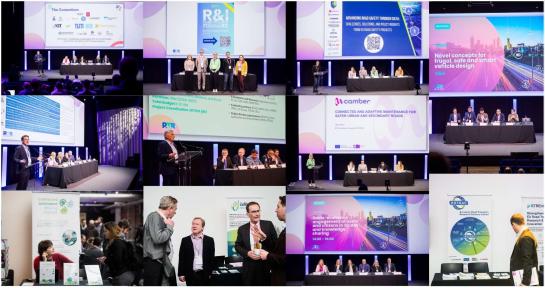
All RTR Conferences presentations are available to view online.
Access the full video playlist here: Access presentations